Most homeowners call them "wires." Garage door techs call them "cables." Same part — the thin braided steel lines that run from the bottom of the door to the spring drum. Here's what just happened, what's safe to do, and how the repair actually works.
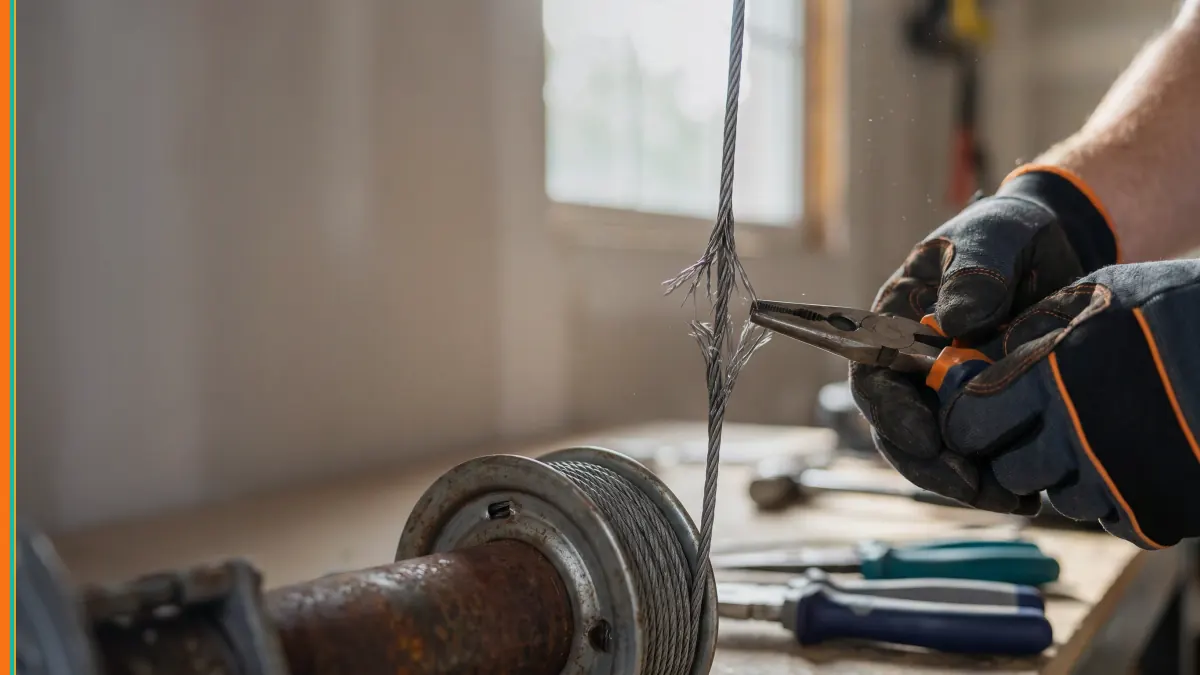
Garage doors have a few things that look like wires:
| What it looks like | What it actually is | If it's broken |
|---|---|---|
| Thin braided steel running from the bottom of the door up to the spring shaft | Lift cable | Door drops, gets crooked, becomes unsafe |
| Thin two-conductor wire near the bottom of the door tracks, going to the small sensors | Photo-eye sensor wire (low voltage) | Door won't close, sensors blink — safe to investigate |
| Wire from the wall button to the opener motor on the ceiling | Wall control wire (low voltage) | Wall button stops working — remote may still work |
| Power cord from the opener motor to the ceiling outlet | 120V power cord | Opener has no power — plug it back in or check the outlet |
| Long stretched spring along the side track with a thin cable through it | Extension spring with safety cable inside | Big problem — this is structural, see spring repair |
If the door is crooked, won't lift, or made a loud bang — you almost certainly have a cable issue, not an electrical one.
If your "wire" snapped and the door is now hanging crooked:
Park outside, keep the kids and pets away from the garage, and call.
A snapped cable has a distinctive look:
If you see any of those, you're dealing with cables. Time to call.
The full repair sequence is on the cable repair page, but the headline is: tech arrives, releases spring tension, swaps both cables (and any damaged drums or brackets), re-winds the springs, balance-tests the door, and recalibrates the opener. Typical visit is 60 to 90 minutes, longer if springs are also being replaced or panels need attention.
The complete cable repair page with failure modes, drum inspection, and pricing context.
If you also heard a loud bang, the spring may have failed too — common with cable failure.
A snapped cable plus a derailed door is a more complex repair — here's what's involved.
A cable problem can look like one loose wire, but it's really a balance problem. Once one side stops lifting evenly, the door can twist fast.
If you see a cable hanging or your door dropped crooked, don't try one more opener cycle. That's usually the moment your repairable door becomes a bent-panel problem.
No. The thing that just snapped and made your door crooked is a steel lift cable, not an electrical wire. Garage doors do have low-voltage wiring (for sensors and wall buttons) but those don't bear weight and don't fail with a bang.
No. Cables are single-piece steel components engineered to a specific length and tension. Splicing creates a weak point that will fail again, often dangerously. The right answer is replacement of both cables at the same time.
Both cables were installed at the same time, have the same age, and have run the same number of cycles. The surviving cable has been overloaded since the first one failed. Replacing one means the other fails within months — another emergency call.
Yes. Springs and cables work as a system. The tech will check spring tension, look for visible damage, and tell you honestly whether they need replacement now, soon, or are fine. If the cable failed because a spring shock-loaded it, the spring may need attention too.
Garage Door Repair Genie techs, both cables replaced, full balance test — same-day dispatch in most markets.
Call (833) 602-3065