Stuck open and the house is exposed? Stuck closed with the car trapped inside? Business locked out before opening? Active emergency calls jump our queue. One phone call gets a tech moving toward you immediately.
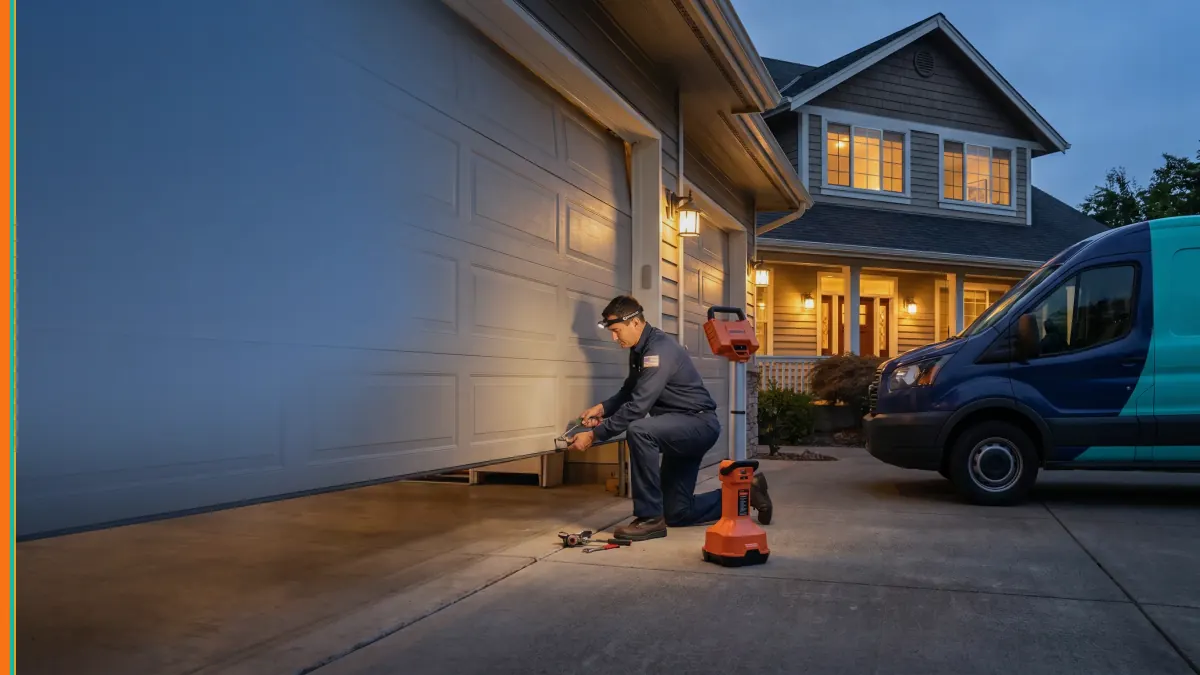
Anything else — intermittent issues, slow doors, noisy travel, sensor blinks — gets scheduled at the next available slot, usually same-day or next-day.
Garage doors weigh 250 to 400 pounds. When the counterbalance system fails, the door can fall fast and won't stop on its own. The actions you take in the next ten minutes determine whether this is a $300 fix or a $1,500 fix.
After-hours and weekend dispatch typically carries a $50 to $150 premium over weekday-business-hours rates. That's how the on-call tech gets paid for showing up at 9 p.m.
| Scenario | Most likely cause | Typical fix |
|---|---|---|
| Door went up, won't come back down | Photo-eye sensor failure or broken cable holding it up | Sensor replacement or cable + balance restoration |
| Door went down, won't open back up | Snapped torsion spring (most common) or stripped opener gear | Spring or gear replacement |
| Heard a bang, door is leaning to one side | One spring broke or one cable jumped the drum | Spring or cable replacement, full rebalance |
| Backed into the door, door now bent or off track | Panel damage, bent track, possibly snapped cable | Track straightening, panel replacement, cable check |
| Storm or wind damage | Bent track, blown-out panels, snapped cables | Damage assessment first, then targeted repair |
| Break-in attempt — door forced | Bent track, damaged opener gear, broken cables | Security-focused rebuild — new opener if forced open |
Three details make the trip faster and the truck stock more accurate:
If you're not sure, just describe what you're seeing. The dispatcher will identify the rest.
These city pages own the exact local emergency garage door repair keyword cluster for each market.
If the door is stuck open, choose emergency repair because the home is exposed. If the door is stuck closed with a car trapped inside, tell dispatch access is the priority. The trade-off is speed versus completeness: the first goal is securing or opening the door safely, then completing the permanent repair.
Emergency calls usually involve a stuck-open door, a trapped vehicle, a crooked off-track door, or a door that will not close at night.
Temporary stabilization matters when a panel is hanging or a cable has jumped the drum because running the opener can bend sections that were still repairable.
The first safe outcome may take less time than the final repair; spring, cable, and track repairs commonly need a 60- to 90-minute window after diagnosis.
Emergency garage door calls are stressful because they usually interrupt something else. You're leaving for work, closing up at night, or staring at an open garage when you wanted to be done for the day.
The first goal isn't a perfect explanation. It's making the door safe. After that, the tech can sort out whether the real culprit is a spring, cable, track, sensor, or opener.
60 to 180 minutes in most service areas during business hours, longer at night or in heavy traffic. The dispatcher gives you a real ETA, not a "sometime today" window. If we can't get there fast enough, we'll tell you upfront so you can make other plans.
For weekday business hours, no — just same-day priority dispatch. For evenings, weekends, and holidays there's a typical $50 to $150 premium over standard rates. The repair work itself costs the same; the premium is for the on-call response.
We can usually still help. A neighbor, family member, or property manager with access can let the tech in. Some calls (broken cable, off-track door) can be diagnosed and quoted without entering, so we can prepare the parts before someone arrives to grant access.
Call right away and tell dispatch you're a commercial site with a hard deadline. We can sometimes route an even-closer tech, and on rare occasions can guide a temporary safe-securing measure (lockout cones, temporary brace) so you can open while waiting for the full repair.
Almost always, yes — but how long it takes depends on whether panels are bent, whether cables snapped, and whether the track itself is damaged. A clean off-track event with no panel damage takes 60 to 90 minutes. Bent panels or damaged tracks add time.
Active emergencies jump the queue. One call, fast dispatch.
Call (833) 602-3065