Honest answer: there is no single number, but there is a real range. Here's what the work actually costs in 2026, what drives the price up or down, and which add-ons are worth saying yes to when the tech is already at your house.
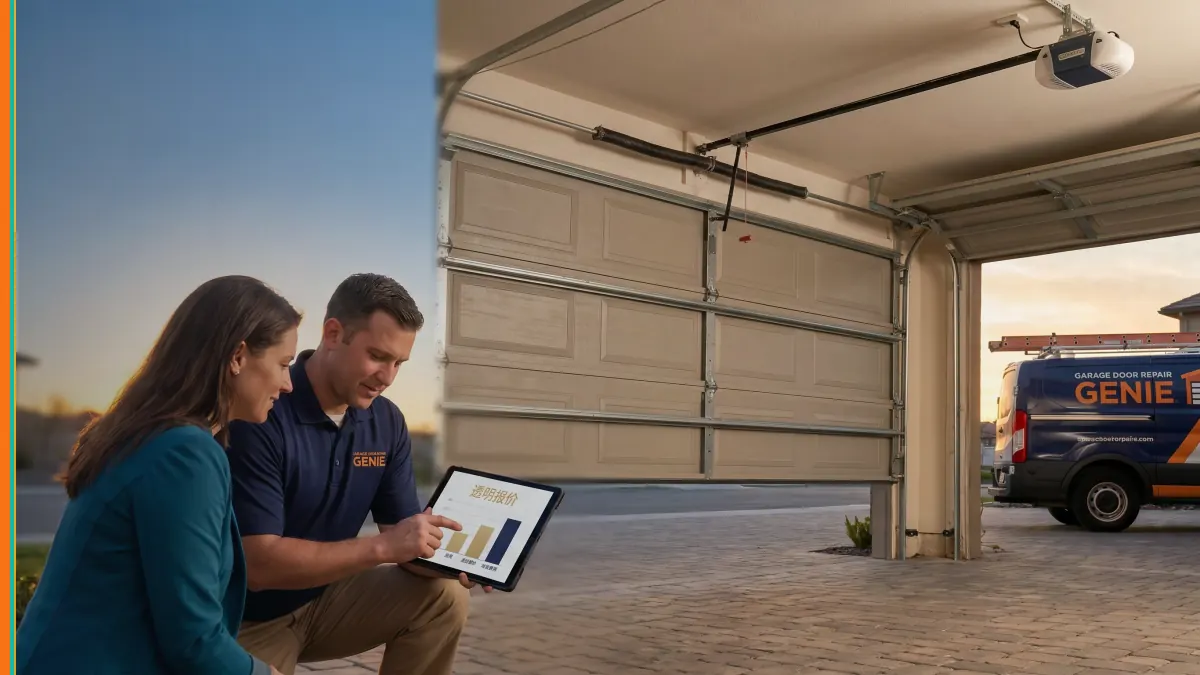
Pricing can vary based on spring type, door size, number of springs, parts, labor, and local availability. Call for a local estimate.
The numbers below come from industry pricing surveys, contractor quote averages, and our own dispatched calls. Your local quote may run higher or lower depending on the factors in the next section.
| Repair | Typical price range | What's included |
|---|---|---|
| Single torsion spring replacement | $150 – $250 | One spring, labor, basic balance check |
| Pair of torsion springs | $250 – $400 | Both springs, labor, balance check, opener recalibration |
| Extension spring replacement (pair) | $150 – $300 | Two springs, safety cables, balance check |
| Springs + cables (combined) | $200 – $500 | Spring pair, cable pair, drum inspection, balance check |
| High-cycle (15,000 or 20,000) spring upgrade | +$50 – $100 over standard | Same labor, longer-lasting springs — pays back over time |
| Emergency / after-hours dispatch | +$50 – $150 | Same repair, premium for off-hours scheduling |
These are realistic ranges, not quotes. Anyone giving you an exact number sight-unseen is either guessing or planning to renegotiate when they arrive.
Six factors decide whether your job lands at the bottom or top of the range above:
When the tech has the door open and the tension released, certain extras cost very little incremental labor and meaningfully extend the next service interval:
Cables and springs work as a pair. Replacing both at once typically costs $40 to $80 more than the spring job alone — and saves a future trip when the cable inevitably wears.
For roughly $50 to $100 more, you get springs rated for 15,000 to 20,000 cycles. On a primary-entrance garage that's an extra 4 to 6 years before the next replacement.
Standard steel rollers are noisy and wear out. Nylon rollers cost $50 to $100 for a set, run quieter, and last longer. Worth it if you've been hearing screeching during travel.
Force settings, travel limits, sensor alignment. After a new spring the opener has to relearn the door balance anyway — a tune-up while the tech is there is usually cheap.
Not every upsell is worth it. Things you can usually decline without consequence:
Reputable techs will explain why each line item exists. If they can't, ask why — and feel free to decline.
A clean quote should break down into these parts:
| Line item | What it should reflect |
|---|---|
| Service call / dispatch fee | $75 – $100, usually waived if work goes forward |
| Spring(s) | Listed by quantity, type, and cycle rating |
| Cables (if replaced) | Listed separately as a pair |
| Labor | Sometimes flat-rate, sometimes hourly — either is fine |
| Opener recalibration / safety test | Usually included, sometimes a small line item |
| Warranty terms | Parts and labor warranty period, usually 1 to 5 years |
The math people don't run before they decide to do it themselves:
For a $200 to $400 difference, a trained tech with the right springs and the right tools is the cheaper path the vast majority of the time.
Both torsion and extension springs explained. Symptoms, what the tech does, and what happens next.
Cycle ratings, sizing, and why two-spring systems get replaced as a pair.
The immediate-action page if you just heard the bang and the door won't lift.
Nobody likes getting a vague repair range. I get it. The reason garage door pricing has a range is that a sensor reset, a broken spring, and a crooked door are completely different calls.
So what should you look at first? Notice whether your door feels heavy, whether one side is lower, and whether your opener is only humming. Those clues usually explain why one repair is cheap and another isn't for you.
Because we'd be lying. A garage door spring job depends on door weight, spring count, spring type, cycle rating, parts in stock, market labor rates, and whether cables get replaced too. Anyone publishing a single number is either pricing for the highest-profit scenario or about to surprise you on arrival.
Most of the bill is dispatch + labor + tension release + balance test. Those are fixed costs whether the tech replaces one spring or two. The second spring adds its part cost and a few minutes of additional install time. You're typically looking at $40 to $80 more for the second spring.
Only if you know your door's exact weight, the wire diameter, the inside diameter, the wound length, and the cycle rating you want. Wrong-spec springs are the most common DIY failure mode. A reputable tech weighs the door first; most kits sold online don't include that step.
For non-emergency repair, yes — two or three quotes will tell you fast if someone's outside the realistic range. For emergency repairs (door stuck open, security risk), you generally take the first qualified tech who can come out.
Sometimes true, sometimes upselling. Ask specifically: "Is the gear stripped, the logic board fried, or just the force settings off?" A gear-only repair is far cheaper than full opener replacement. Demand specifics before agreeing.
Garage Door Repair Genie techs give flat-rate quotes after a quick on-site inspection. No exact-price guarantees over the phone — only honest ranges.
Call (833) 602-3065